The Coastal Cleanup Information Platform
In recent years, coastal environmental maintenance has become an issue of growing international concern, while public awareness of beach cleanup activities continues to increase. The Coastal Cleanup Information Platform integrates functions including coastal cleanup statistics and results inquiry, public beach cleanup applications, coastal adoption applications, coastal litter reporting, and coastal jurisdiction inquiry services. It serves as a convenient platform for central government agencies, local governments, the public, businesses, and civil organizations to participate in coastal environmental maintenance, while also providing access to information on the government's coastal cleanup efforts and related achievements, working together toward clean and sustainable coastal environments.
Coastal Cleaning and Maintenance
When discussing Taiwan's coastal environment, we must mention its rich marine resources and diverse ecosystems. However, this beautiful coast faces numerous issues, such as driftwood, discarded fishing nets and other debris, which mar the landscape and harm the health of the marine ecosystem. To protect our ocean environment, coastal cleaning and maintenance have become an urgent task.
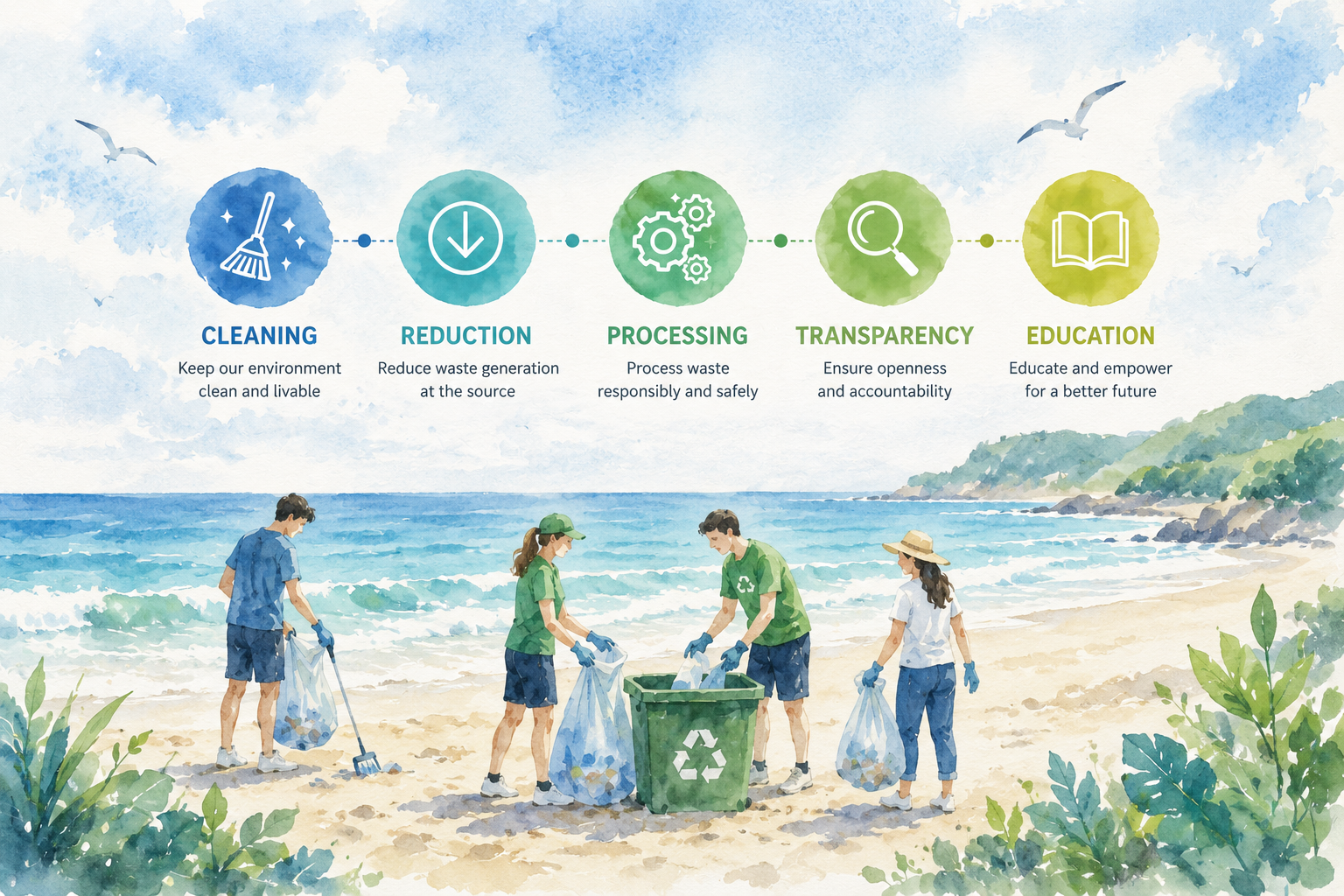
The "Salute to the Seas, the Coastal Cleaning and Maintenance Project" aims to promote the development of a friendly ocean environment through the five main aspects of cleaning, reduction, removal, transparency, and education. This project's goal is to establish an effective coastal cleaning management system, reducing coastal debris generation at the source, and ensuring that the coast remains clean at all times.
Five Aspects of Building a Friendly Ocean
When it comes to Taiwan's coastal environment, we have abundant marine resources and a diverse ecosystem. However, due to factors such as human activity, terrain, and tides, the coast is often troubled by driftwood, abandoned fishing nets, and other debris, which spoils the beautiful coastal landscape. To ensure that our beaches remain clean at all times, we need to clearly define the responsible parties for coastal cleaning, establish an effective cleaning mechanism, and reduce waste generation from the source, continually reviewing and improving our practices.
The "Salute to the Seas, the Coastal Cleaning and Maintenance Project" introduces five main aspects to promote a friendly ocean environment: cleaning, reduction, removal, transparency, and education. We need to build a system and ensure its implementation, creating concrete, feasible, and persistent plans to guarantee that every inch of the coast is properly managed, keeping our shores clean and making Taiwan a truly beautiful island.
Specifically, we should clearly designate a coordinating body for coastal cleaning and maintenance, with a reasonable division of labor to ensure that every inch of the coast is properly cleaned. Additionally, through source reduction, we should decrease the amount of coastal debris needing cleanup each year. After natural disasters, driftwood and debris should be cleared within seven days to ensure the rapid restoration of the coastal environment.
Coastal Cleaning and Maintenance Flowchart
Clean-up Actions
Volunteers & groups clean the beaches.
Data Recording
Upload cleanup results and photos.
Classification
Separate recyclable and non-recyclable waste.
Transportation
Cooperate with local cleanup authorities.
Proper Treatment
Recycled or sent to incinerators/landfills.
Coastal Cleaning and Maintenance Project
With the establishment of the Taiwan Marine Debris Governance Platform in 2017, the Coastal Cleaning and Maintenance Project was launched through public-private collaboration. The "Salute to the Seas" initiative includes the five main aspects of cleaning, reduction, removal, transparency, and education, and coordinates efforts across various departments. After 2020, coastal cleaning efforts have shown results, reducing coastal debris by 66%. Therefore, in 2023, the Executive Yuan approved the second phase of the "Salute to the Seas, the Coastal Cleaning and Maintenance Project," which continue coastal cleaning and maintenance operations, the "Salute to the Seas - Coastal Cleaning and Maintenance Program (2024-2027)" was also approved in 2024 for performance evaluation and implementation, with the aim of institutionalizing the "Salute to the Sea" initiative. In the future, a third-phase Coastal Cleaning and Maintenance Program, This will encourage all departments to maintain the coastal environment in accordance with the principles of "scheduled, immediate, and urgent cleaning" thereby achieving sustainable development of the ocean.
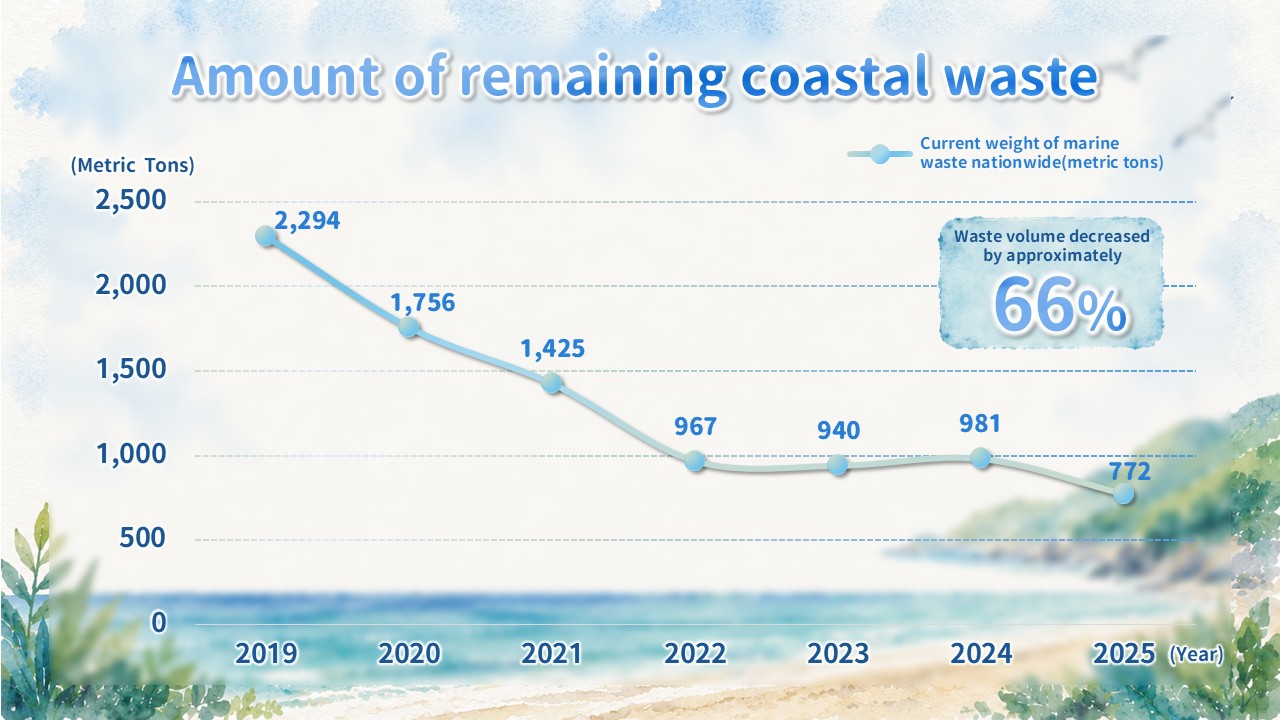
Amount of Remaining Coastal Waste
Reduced by 75%
Taiwan Coastal Cleaning Action Report
1. Cleaning Efforts
Coastal management entities conduct regular cleanups based on crowd levels. Between 2020 and 2025, 362,000 tons of coastal debris were removed.
For reported cases of coastal pollution, cleaning personnel were dispatched immediately, with an average response time of about 3.8 days. 2,860 reports were handled.
Prior to typhoon events, coastal management authorities are reminded to expedite coastal cleanup operations. Immediately after the typhoon passes, personnel are dispatched to conduct inspections and assess coastal conditions. If any littering or pollution is identified, it is promptly reported through the Coastal Cleanup Information Platform.
2. Technology Application and AI Identification
Based on the 168 national coastal rapid screening stations, two beaches over two kilometers in length were selected as practical verification sites for aerial photography. In 2025, 30 aerial photography missions were completed.
During the aerial photography missions, 22 cases of coastal uncleanliness were reported. After being handled by the respective coastal management authorities, the amount of waste cleaned up reached 18.6 metric tons, including 4.4 metric tons of recyclable waste and14.2 metric tons of non-recyclable waste.
Completed the development of AI automated identification and marking technology for coastal waste on sandy shorelines. By increasing the number of training samples and optimizing algorithms, the AI system's consistency with manual identification improved to 80%, significantly enhancing the efficiency and application value of image recognition.
3. Coastal Cleanliness Monitoring
Regular monitoring commissioned by the Ministry of Environment shows that coastal debris in 2025 decreased by 66% compared to 2019.
4. Land-Source Pollution Control
Established 108 temporary storage sites and removed 50,647 tons between 2020 and 2025.
Between 2020 and 2025, 91,484 tons of river waste were intercepted, reducing the flow of land-based waste into coastal areas.
5. Adopted Beach Management
Implemented on July 1, 2021, with 100% compliance by the end of 2025, and a total of 239 reports received.
Established 24 temporary storage sites, processing approximately 122,623 tons of waste.
Subsidized 215,265 alternative, non-styrofoam floats between 2020 and 2025.
Between 2020 and 2025, over 1,478 tons of discarded fishing nets and styrofoam were recycled, with a reuse rate of nearly 72%.
Future Outlook
In September 2023, the Executive Yuan approved the second phase of the "Salute to the Seas, the Coastal Cleaning and Maintenance Project." From 2024 to 2027, nearly NT$5.9 billion will be allocated, focusing on the five aspects of "cleaning," "reduction," "removal," "transparency," and "education," establishing a coastal cleaning and maintenance mechanism from mountains to rivers, ports, and seas so relevant works are integrated into and implemented through policies long term in order to comprehensively strengthen marine development affairs, ensure sustainable ocean development, and encourage citizens to "clean, know, approach, and enter the ocean," working toward the policy vision of "every inch of coastline managed, and every inch of land kept clean."